


Maghras is a farm and community space in Al Ahsa, Saudi Arabia where local and visiting artists, architects, farmers, cultural practitioners, and community members converge and reflect on the transformations of their lived environment. The project fosters dialogue while evolving a new typology of the farm as a public space—one that hosts studios and programmes for community engagement within an agricultural setting. Through Maghras, practitioners translate their experiences and research into participatory frameworks and experimental, site-responsive productions.

An exploratory workshop at the Maghras base farm organised by a local children’s library, Marj, weaving stories about native ecology. © Abdullah Alshaikh

Gathering at Ali Al Haji’s farm following one of Maghras’ programmes; a morning walk through the ancient village of Al Battaliya.
© Maghras

A film screening of Donkey Race by Mohammed Baqer at Maghras.
© Moath Alyahya

Triennale Milano
The exhibition Maghras at the Triennale di Milano shares research and artistic commissions that are a springboard for a longer continuum of work that engages and reimagines future trajectories for repair and revival.

The exhibition title, Maghras, refers to the traditional measuring unit that describes the space delineated by four palm trees. The unit is transplanted and interpreted as a symbolic frame for the terrain of process and discourse, including the conversations, material traces, soundscapes of field recordings, and speculative gestures emerging from the farm.
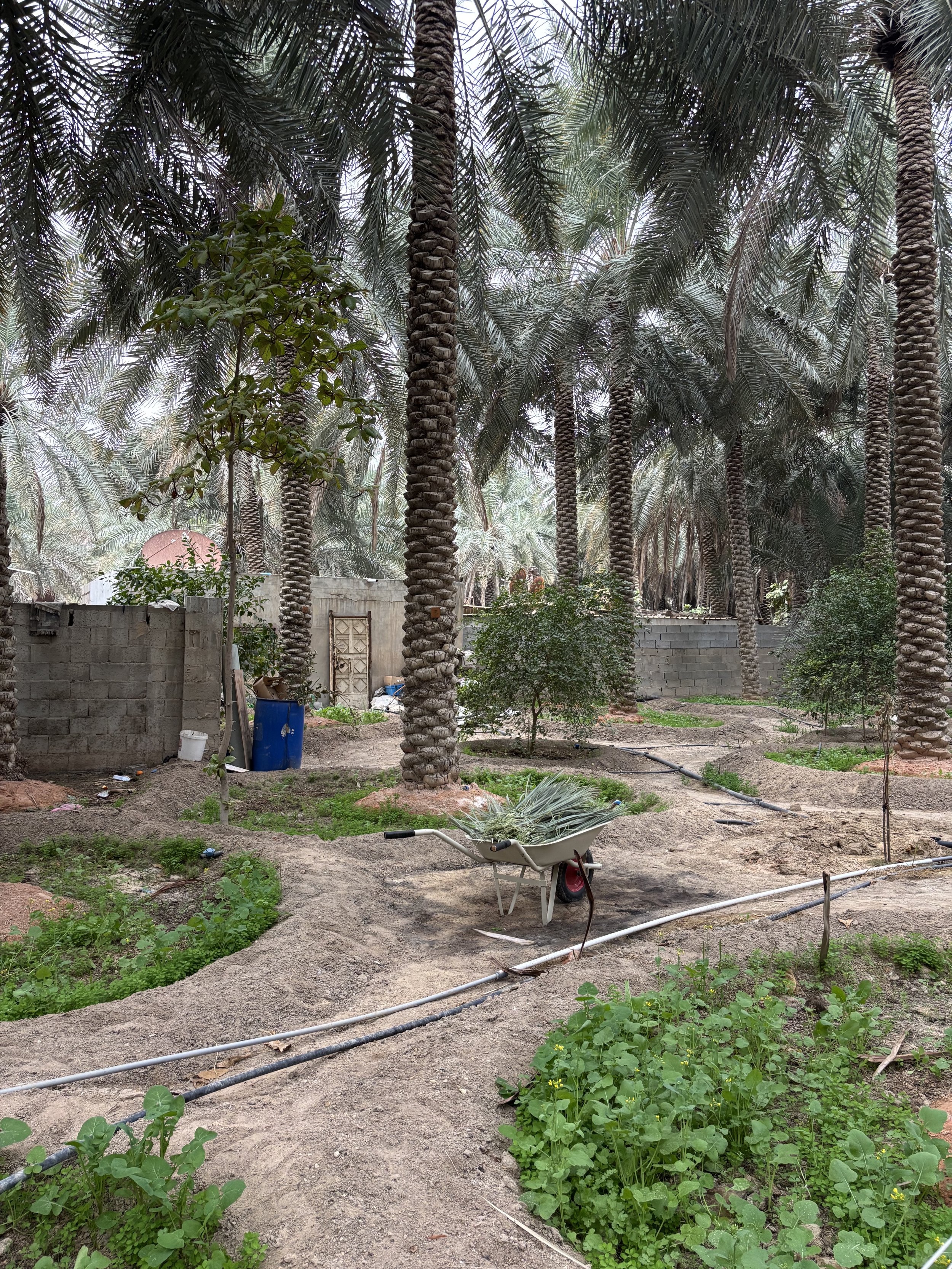
This spatial and conceptual grafting invites audiences into the core of Al Ahsa’s evolving agroecosystems to reflect on a series of questions central to Maghras’ work: How do we preserve the threads of a rural condition under the pressures of homogenous urban growth? How can we support the decentralised and fragile knowledge systems that are at risk of disappearance? And what forms of repair might reconnect the severed bonds between people, place, ecology, and practice?
May 13 – November 9, 2025
Triennale Milano
Viale Alemagna, 6
20121 Milan
Italy


About Maghras
THE FARM
Maghras is a farm and community space in Al Ahsa, Saudi Arabia. Since 2024, Maghras has been graciously hosted by the Abdulmonem Alrashed Humanitarian Foundation farm, a space integral to the pavilon’s programs and conversations aimed at fostering alternative forms of resilience building within the Al Ahsa community.
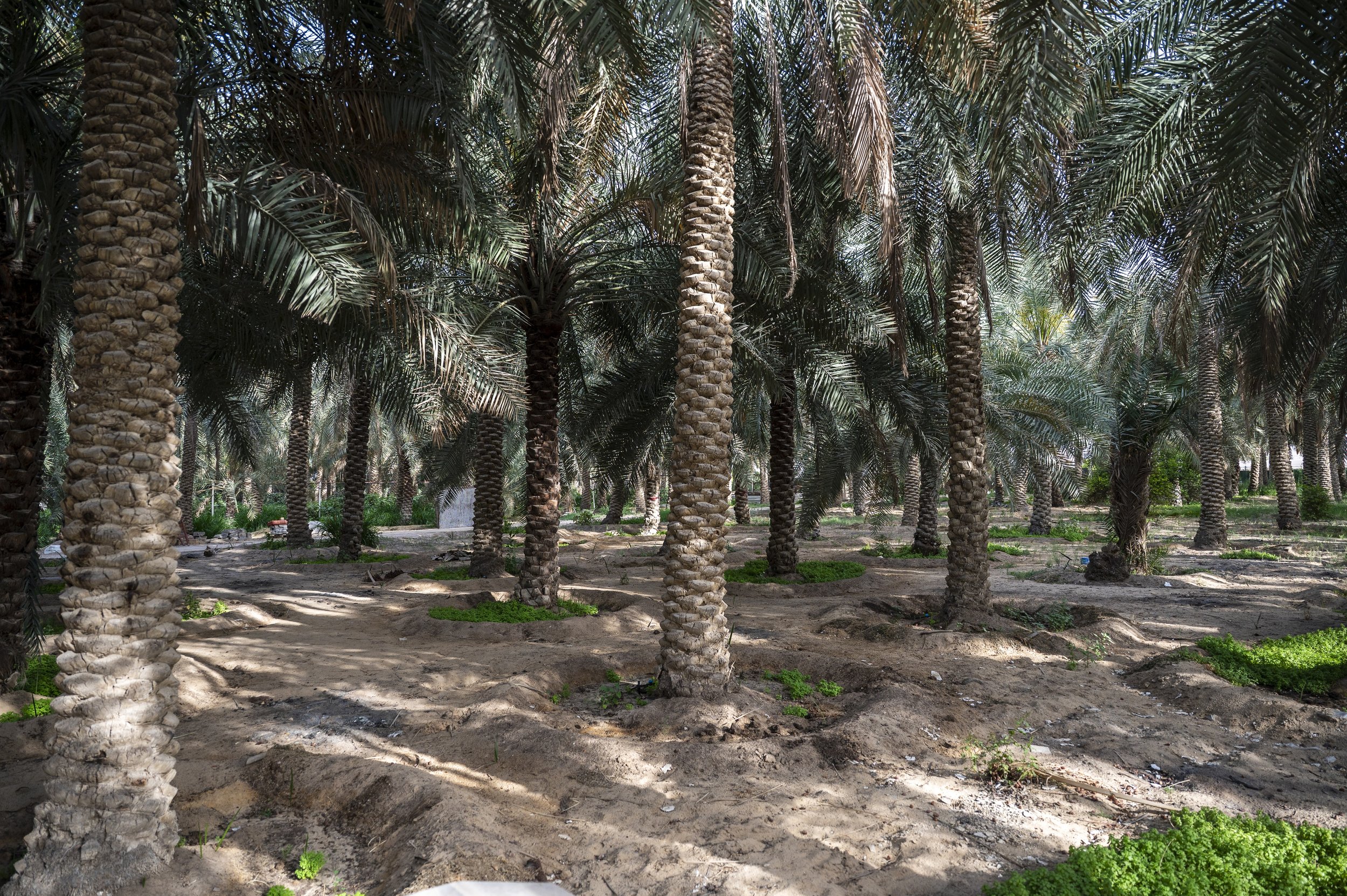
© Maghras
THE METHODOLOGY
Driven by the belief that Al Ahsa has been studied and represented predominantly through a technical lens, the project team embarked on a comprehensive exploration to uncover the region’s history, cultures, ecologies, and the stories embedded in its agricultural and rural landscapes. The research looks at the rich knowledge systems— many on the verge of disappearing— and examines their relationship with the evolving spatial fabric and rural infrastructures of modern Al Ahsa

© Maghras
The exhibition’s approach expanded beyond conventional resources to include:
ORAL NARRATIVES
Engaging in one- on-one conversations with 25+ farmers, craftspeople, architects, tradespeople, heritage preservationists, and policy makers in various settings.
CULTURAL EXPRESSIONS
Drawing from literature, poetry, and songs to understand the perspectives of the community and the ways they perceive and articulate the changes in their environment over time.
ARCHIVAL RESEARCH
Delving into archives, from institutions like Aramco, Al Darah and the Saudi Irrigation Organization— including drawings, plans, and reports, to trace the visions and strategies that have shaped the region’s Development.
MEDIA
Examining photographs, films, GIS data and audio recordings that are both historic and contemporary to reconstruct contexts and analyse spatial and environmental conditions.
PROGRAMS AND COMMUNITY ENGAGEMENT
Artists, architects, and cultural practitioners collaborated with the researchers to translate findings and emerging questions and themes into programmes and participatory frameworks —guided walks, somatic workshops, and speculative design workshops— that sought to foster community engagement, collective analysis, and propose experimental approaches to imagining new possibilities and realities.

Ahmed Msallami, a rice and date farmer, shares his experiences with the research team, discussing the changes he has witnessed in his environment throughout his career.”
© Maghras

Abu Adel, a rice farmer and folk musician, performs songs on the oud at the Maghras farm.
© Abdullah Alshaikh

The research room in the farm features a timeline wall, revealing the infrastructural changes that unfolded in the landscape over the years.
© Abdullah Alshaikh
Commissions

LEEN AJLAN (Saudi Arabia, 1997)
Canopy and Harvest Veil, 2025
Produced in collaboration with Mhairi Boyle
Canopy Weavers: Mhairi Boyle, Abbas Al Sadadi, Habib Al Rasool
Harvest Weavers: Ayat Hassan Al Humaid, Zainab Abduljabbar, Hasan Juma
Investigating the expansion of agrarian monoculture and the impact of artificial fertilisers (phosphates) on soil and water quality in Al Ahsa, Leen Ajlan experimented with circular strategies that reconnect craft with agricultural practices through immediate applications in date farms. The Canopy and Harvest Veil encourages the growth of diverse food forests—now in decline—including pomegranates, figs, and Turunj. The covers not only support biodiversity and soil regeneration but also contribute to the production of naturally sized organic dates by protecting the fruit as it grows.
Designed and produced following interviews with Hasawi farmers and in collaboration with local craft communities, the textiles allow craft knowledge (such as medad and khos weaving) to be integrated into agricultural innovation. Composed entirely from natural materials, the structure uses farming byproduct waste to replace what would typically be made of plastic. The work fosters connections between different knowledge systems and creates economic opportunities for local craft communities while combating waste and pollution in Al Ahsa’s farms.

Sawtasura foregrounds women’s oral histories and sonic memory as forms of environmental knowledge—knowledge often distorted or excluded by dominant narratives of development. It brings to light intergenerational knowledge and stories that can help us remember and reimagine how we relate to nature at a time when our bonds with the landscape have frayed.
Through a series of workshops incorporating deep listening, sounding, movement, and dream journaling, Sawtasura created space for social and ecological tensions to be met with openness and a willingness to repair.
The resulting sonic essay, presented in this pavilion, draws from recordings and conversations that emerged during these sessions. It does not aim to represent but to hold together fragments of grief, joy, humor, and faith. In doing so, Sawtasura explores how memory can operate as a dynamic force for new thinking—shaping more integrated futures for generations to come.

MOHAMMED ALFARAJ (Saudi Arabia, 1993)
What Is the Frog Saying?, 2025
In Mohammed Alfaraj’s work we encounter reflections on the possibilities and contradictions that emerge through interspecies collaborations. Drawing from oral traditions, his immersive film and series of clay sculptures tell the story of a palm tree named after a woman, Taleya, who drowned in a nearby spring, becoming a landmark in his village. The narrative is recounted by a frog that was historically found around Al Ahsa’s water canals but is now rarely seen. Through this gesture, Alfaraj offers a reflective lament, an attempt at embodied listening during a moment of emotional and ecological dissonance. He invites us to consider how memory, nature, and storytelling remain intertwined, even as the ecosystems that sustain them begin to vanish.
Maghras Team
-
A landscape architect based in Saudi Arabia, is one of the co-curators of Maghras, A Farm for Experimentation. She specializes in urban regeneration and ecological restoration. Having worked in London, Istanbul, and Abu Dhabi, she brings a global-local perspective to her work.
She served as an advisor to the Vice Minister of the Ministry of Municipalities and Housing from 2022–23, focusing on Saudi Arabia’s community parks strategy. At Arup, she led the development of the Urban Transformation Manual launched by the Saudi Architecture and Design Commission in 2024—a comprehensive initiative dedicated to regenerating public spaces. She continues to serve as a jury member for national design awards in the Kingdom. She studied at the American University of Sharjah and Columbia University in New York. In 2024, she co-founded Maghras with Sara Al Omran, a farm and community space in Al Ahsa.


-
She formerly served as the Deputy Director at Art Jameel, where she led the launch and development of Hayy Jameel, a multidisciplinary arts complex with a particular mandate to support artists through residencies, commissions, and bespoke learning programs. Prior to working at Art Jameel, Sara worked as a management consultant with Monitor Group and the Boston Consulting Group, focusing on education and social impact projects. She is the co-founder of Maghras, a farm and community space in Al Ahsa launched in 2024 with Lulu Almana.
-
An architect and creative director specializing in exhibitions and museological environments, is the Creative Director of Maghras, A Farm for Experimentation. His core interest is in creating holistic experiences structured by the integration of art, architecture, and design.
Along with Frank J Mondragón, Alejandro is a founding partner of world, an architecture and design studio focused on exhibitions and publications. He is also the Director of Exhibition Design at the Fine Arts Museums of San Francisco and previously worked as Senior Exhibition Designer for The Metropolitan Museum of Art, where he designed several major exhibitions and contributed to the redesign of the Michael C. Rockefeller Wing for the Arts of Africa, Oceania and the Americas. Alejandro holds a Masters of Architecture from Columbia University.
-
A Bahraini architect, researcher, and educator whose work navigates the intersections of materials, landscapes, and energy systems, with a focus on circularity. Her approach moves between narrated world-building and precise technical resolution, bridging speculation with groundedness.
In 2023, Alkhayat co-curated Sweating Assets, the National Pavilion of the Kingdom of Bahrain at the Venice Architecture Biennale, where she foregrounded critical conversations around thermal comfort and environmental resilience. Her experience in architectural practice spans the UK, US, and Bahrain. Alkhayat earned her Master of Architecture from the Massachusetts Institute of Technology (MIT) in 2023, where she later taught and received numerous honors, including the prestigious AIA Certificate of Merit. She is the co-founder of Maraj (2024) and Harness the Heat (2021).
-
Leen Ajlan is an architectural designer from Jeddah, Saudi Arabia, whose work navigates the intersection of spatial design, cultural narratives, and material experimentation.
Rooted in a deep engagement with Arab heritage, her practice explores the ways in which architecture can facilitate communal interactions, revive traditional craftsmanship, and support ecological regeneration. Leen holds an MA in Architecture from the Royal College of Art in London, where she is currently based. Her work has been exhibited internationally, including at Milan Design Week, AlUla Design Festival, Paris Design Week, and the Venice Biennale. Through a multidisciplinary approach, she continues to investigate the evolving role of architecture in shaping sensory, cultural, and ecological landscapes.


-
Sawtasura is a socially engaged research platform dedicated to non-tangible heritage and art forms in the Arab Gulf and wider region.
The platform was founded in 2020 by Tara Al Dughaither (Dhahran, Saudi Arabia), an independent arts curator, artist, and cultural producer focusing on process based methods of embodied learning and expression. Al Dughaither holds a masters in Culture Crticisim and Curation from Central Saint Martin’s London, (2013) and has worked across private and government sectors as well as grass roots initiatives.
-
Mohammed Alfaraj is a visual artist that works in film, photography, sculpture and poetry, influenced by his hometown and his travels.
Alfaraj attempts to capture the imprint and impact of life both literally and metaphorically. Having studied engineering and growing up loving the camera in Al-Ahsa, Saudi Arabia, Alfaraj’s work can be described as a cinematic collage of mediums, practices and ideas. With his artwork and projects, Alfaraj aims to create a world charged with stories, poetry and the search for truth via exploration, documentation and interpretation, resulting in works that the artist hopes nurture imagination and empathy. His use and reuse of organic and manmade waste work as a physical capsule of memories and time, with these materials and their histories holding a spiritual quality. Alfaraj also engages in workshops and action-based activities with the community as a believer in collective creativity.
-
Rawan is an anthropologist, folklorist, and oral historian. Her DPhil research explores how the environmental change of early twentieth-century Saudi Arabian urbanisation reshaped bodylore—the deep connection between daily bodily movement, folkloric performances, and the environment’s cosmological significance. Focusing on Najd, the central region, she traces shifts in bodylore amidst the ecological transformation of migration from Najdi mud villages to Riyadh. She is pursuing her PhD at Oxford University.
-
Mohamed Al Mubarak is a historian and researcher. He holds a BA in History and Middle Eastern Studies from NYU Abu Dhabi and a Master’s in Global History from Humboldt University. His interests include the social and urban histories of the Middle East, specifically pivotal historical nodes in the Gulf as they intersect with the development of literary movements and archival practices.
-
Rend Beiruti is a writer and urbanist. She holds a BA in Middle Eastern Studies and Theater from NYU Abu Dhabi and an MSc in Urban Development Planning from The Bartlett, University College London. Her research interests include the social, cultural, and urban development histories of the Middle East.
-
Researcher, strategist and city planner focused on spatial mapping, climate justice, racial equity and achieving systemic change at the local, regional and global scale. Skilled writer & analyst with qualitative and qualitative bona fides. Proficient in GIS, Python and Adobe Creative Suite.
-
Nada AlMulla is a Saudi architect and urban designer with an interest in exploring the interplay between culture and technology in architectural practice. Nada received her Master of Architecture from the Massachusetts Institute of Technology (MIT) and her Bachelor of Architecture from the American University of Sharjah (AUS). She has extensive design experience in both Saudi Arabia and the US, and is driven by a commitment to enhancing the built environment. Nada is the recipient of the Christo and Jeanne Claude Award ’15, The Abu Dhabi Art Pavilion Prize ‘17, the MAD award from the American University of Sharjah '17, and a Regional prize of the Undergraduate Awards '17.
-
Ghaidaa Gutub is an architect and multimedia artist from Jeddah. She holds a Bachelor’s degree in Architecture from Effat University in Jeddah (2017) and a Master’s in Advanced Architectural Design from Columbia University in New York (2020). She worked at Bricklab on design and creative projects until 2023, and is currently part of the design team at Diriyah Company in Riyadh. Ghaida participated in the 2018 Design Exhibition with the installation Nur ‘ala Nur, and in the 2023 Islamic Arts Biennale in Jeddah with a video installation. She is currently part of the research team at the experimental research farm.
-
Tara Aldughaither (Dhahran, Saudi Arabia) is an independent arts curator, artist and cultural producer focusing on process based methods of embodied learning and expression. She is the founder of Sawtasura (since 2020), a socially engaged research platform deciated to non tangible heritage and art forms in the Arab Gulf and wider region. She holds a masters in Culture Crticisim and Curation from Central Saint Martin’s London, (2013) and has worked across private and government sectors as well as grass roots initiatives.
-
Mariam Al Noami is an artist and urban designer whose work explores the intersections between people and their environment, often grounded in research and community engagement. She holds a Master’s degree in Urban Design from the University of Colorado (2017). Her work has been exhibited in numerous regional and international art venues, including Sharjah Biennial 16 (UAE); Hayy Jameel (Saudi Arabia); NYU Abu Dhabi Art Gallery (UAE); Bahrain Annual Fine Arts Exhibition; Al Riwaq Art Space (Bahrain); Saatchi Gallery (UK); and in 2019, her work was featured in the exhibition “Waiting” held in parallel with the Venice Biennale in Italy.
-
Ali is an architect with a passion for craftsmanship and a deep interest in local cultural heritage, the environment, and earthen architecture. He earned a Bachelor’s degree in Architecture from King Fahd University of Petroleum and Minerals and pursued further education in traditional earthen construction through the Royal Institute of Traditional Arts program. He gained hands-on experience by working on various projects across different regions of Saudi Arabia, with a focus on the restoration of heritage buildings. He is currently serving as a Heritage Conservation Officer at the Diriyah Gate Development Authority.
-
Ghaidaa Gutub is an architect and multimedia artist from Jeddah. She holds a Bachelor’s degree in Architecture from Effat University in Jeddah (2017) and a Master’s in Advanced Architectural Design from Columbia University in New York (2020). She worked at Bricklab on design and creative projects until 2023, and is currently part of the design team at Diriyah Company in Riyadh. Ghaida participated in the 2018 Design Exhibition with the installation Nur ‘ala Nur, and in the 2023 Islamic Arts Biennale in Jeddah with a video installation. She is currently part of the research team at the experimental research farm.
-
Mhairi Boyle is a textile artist and designer whose work centers on researching natural materials and dyes. She focuses her practice in Bahrain and the Gulf region with the aim of preserving and developing the use of local fibers and dyes. Mhairi works directly with artisans in Bahrain to support the weaving craft, which is currently in decline, and seeks to revive traditional approaches to the craft while encouraging collaboration among artisan communities across the region. Since returning to Bahrain after graduating from art school in England, she has spent the past five to six years working closely with local artisans to help sustain and evolve this rich cultural heritage.
-
Fatima is a storyteller with a deep interest in the relationship between humans, nature, and the land through stories and oral narratives. She is the founder of Marj Library, the first read-aloud library in Saudi Arabia, located in Al-Ahsa, with a focus on children’s literature and storytelling. She holds a Bachelor’s degree in Arabic Language from King Faisal University. Her work has been featured in numerous local, regional, and international events, including the Al Rawi Festival in Sharjah, where she presented stories about plants and birds over two consecutive years (UAE); the Morocco Tales Festival (Kingdom of Morocco); in addition to many workshops held in the farms of Al-Ahsa.
-
Abbas is a Bahraini artisan who has practiced the craft of midad weaving for over 22 years, becoming one of the most skilled practitioners and among the few remaining who still work with the esel plant in the region. Although the craft was not passed down through his family, Abbas learned it at a young age under the guidance of the late master artisan Haji Hussein Al-Muallim. He also worked at the Jasra Handicrafts Center in Bahrain, where he played a role in reviving this traditional art form
-
Saleh Al Humaid is a master craftsman and the last remaining practitioner of the endangered midad weaving craft in Al-Ahsa, Saudi Arabia. Born and raised in a community deeply rooted in palm-based traditions, Saleh has dedicated his life to mastering the intricate techniques of weaving with esel—a native plant once widely used in the region. With decades of experience passed down through generations, he continues to preserve this heritage craft with exceptional skill and devotion. His lifelong practice stands as a testament to the cultural resilience of Al-Ahsa’s artisanal legacy
-
A graphic designer specializing in exhibitions and publication design, currently serves as Senior Designer at The Metropolitan Museum of Art in New York. His practice centers on visual storytelling through spatial and printed formats. Outside of his work at the Met, he runs world, a design studio co-founded with Alejandro Stein, through which he collaborates with institutions such as The Warhol Museum, Isabella Stewart Gardner Museum, and the Arts Club of Chicago. His approach combines clarity, typographic precision, and a sensitivity to curatorial intent. He is based in New York City.
-
Khaled Esguerra is a photographer, visual artist and designer from Abu Dhabi. He holds a bachelor’s degree in Visual Communication from the American University of Sharjah. Esguerra is currently an artist-in-residence at 421 Arts Campus in Abu Dhabi and has exhibited his artworks across several institutions in the UAE.
As a freelance designer, he specializes in bilingual Latin/Arabic editorial design and exhibition identity, working with clients such as the Bahrain Pavilion at the Venice Architecture Biennale, DCT Abu Dhabi, Art Jameel, Bayt AlMamzar, and the Saudi Pavilion at the Triennale di Milano in 2025 with Frank Mondragon of world.

Publication
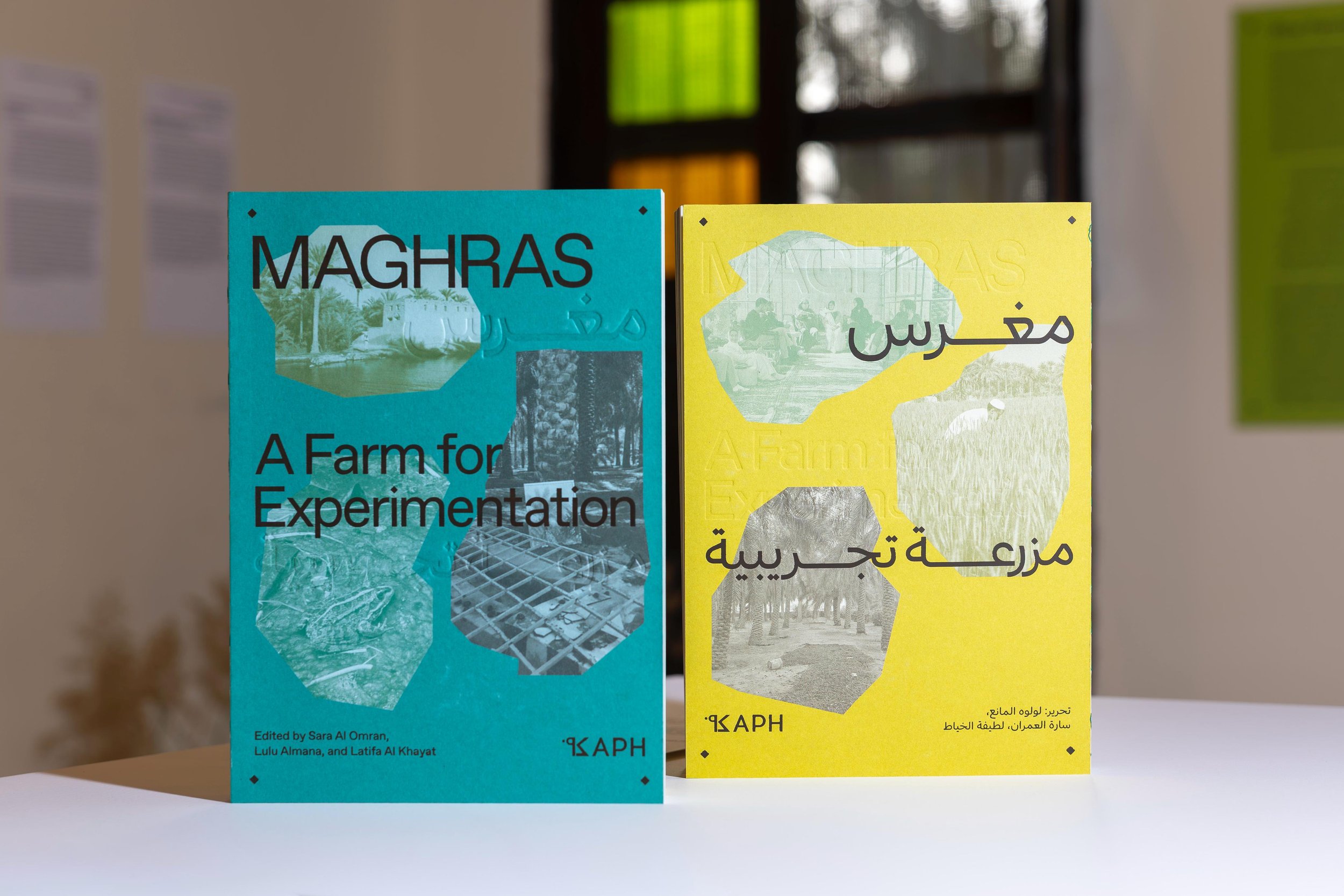
Published on 1 February 2026, Maghras: A Farm for Experimentation brings together months of research, documentation of programming, and wider conversations on agriculture, infrastructure, and intangible heritage. The publication is available for purchase through Kaph Books and selected bookstores internationally, as well as online.
Structured through a series of commissioned illustrations that set the rhythm of the book, the publication traces a story of Al Ahsa through the entanglements of ecology, community, craft, water infrastructure, and history. With oral history as a central research methodology, the book engages storytelling alongside critical reflections from the Maghras team and invited regional practitioners.
Editors: Lulu Almana, Sara Al Omran, and Latifa Al Khayat
Authors: Civil Architecture, Deema Al Ghunaim, Dzidula Courage Kpodo, Fatima Al Hajji, Fatma & Reem Al Sehlawi, Ghaidaa Gutub, Latifa Al Khayat, Leen Ajlan, Lulu Almana, Mariam Alnoaimi, Mohammed Al Faraj, Sara Al Omran, Sawtasura, and Thamer Al Sunaidi.
Illustrations: Nada Al Mulla
Maps: Hayes Buchanan
Publication Design: world Frank Javier Mondragón with Khaled Esguerra
Copyedited, translated, and published by Kaph Books
https://www.kaphbooks.com/books/maghras-farm-experimentation/
Maghras invites you to join The Umm Sab’aa Storytellers, a community circle led by artist Jumana Emil Abboud, inviting participants to explore storytelling in relation to water in the oasis landscape near Maghras. Working with local folktales, water traditions, and lived experiences, the group will explore stories connected to wells, springs, land, and the imagined dimensions that shape how the oasis is understood and inhabited. Through deep listening, dialogue, and collaborative writing, participants are invited to reflect on the social, ecological, imaginal, and unseen layers of the landscape.
Over two weeks, the Umm Sab’aa Storytellers will work closely together to shape narratives that respond to the changing conditions of the oasis and to imagine how its water lore might speak into the present. The program includes interventions by cultural practitioners, including Sara Al-Omran and Lulu Almana (Maghras), Fatima Al-Hajji (Marj Children’s Library), Maria Alem (Khunfus Publishing), and Nouf Al-Harthi (writer, researcher, and cultural practitioner). The program concludes with a public gathering and reading bringing together inherited water lore and newly created stories.
The Umm Sab’aa Storytellers
by Jumana Emil Abboud
-
Field visits to springs and lakes
Writing, storytelling, and performance workshops
Interventions by cultural practitioners
Dialogues and intimate circles.
A collective public performance
-
Cluster One: Drawing – In the oasis landscape near Maghras, we gather folktales, water practices, and lived memories connected to water and to land. Drawing here is akin to drawing water from a well, and it is approached as a form of seeking and attention — looking deeply into memories, histories, oral traditions, and experience to find stories and to bring them forward. This cluster includes a visit to nearby springs led by Maghras founders, as well as a session at the Marj Library delving into books around Hasawi folktales.
Thursday, April 9, 5-8 PM
Friday, April 10, 5-8 PM
Saturday, April 11, 2-5 PM
Cluster 2: Passing the Cup – This cluster focuses on circulation and exchange, on language and collaboration. As water sustains life by moving from hand to hand, stories begin to take form as they travel between us. Drawing on the meaning of siqāyah — offering and shared custodianship — participants explore how language, memory, and gesture are carried, translated, and reshaped in relation to others (where the other is non-human; ancestor etc). This cluster includes an intervention by Khunfus Publishing around writing with flora and fauna, as well as collective writing and mythmaking sessions.
Monday, April 13, 5-8 PM
Wednesday, April 15, 5-8 PM
Cluster 3: The Water Table – This cluster gathers what has been drawn and circulated and brings it into shared reach. Around a common table, participants place stories, fragments, and reflections between them — not as individual works, but as material for collective shaping. This cluster includes a site visit to Al-Asfar Lake and an intervention by writer and researcher Nouf Al-Harthi, where she shares her poetic work about the Red Sea.
Saturday, April 18, 11 AM-8 PM
Cluster 4: The Overflow –This cluster brings the collective script into voice. Through spoken word and public sharing, the stories shaped together emerge as a shared expression rooted in the oasis and its living narratives.
Tuesday, April 21, 5-8 PM
Thursday, April 23, 5-8 PM
Friday, April 24, 12-8 PM
-
Jumana Emil Abboud is a Palestinian artist whose practice spans drawing, video, performance, and text, exploring memory, loss, and resilience. Her work draws on folklore, waterlore, and Palestinian heritage.
Media Center
For press inquiries, please contact Paula Ramírez
+49 152 2816 0208
Featured articles
E-flux
https://www.e-flux.com/announcements/660242/maghras-a-farm-for-experimentation/
https://www.e-flux.com/announcements/669632/maghras-a-farm-for-experimentation/
Arab news
https://www.arabnews.com/node/2600089/lifestyle
Saudi Press Agency
https://www.spa.gov.sa/N2284697
AlMadina
https://www.al-madina.com/article/927764
Asharq Alawsat Ar
https://aawsat.news/nrcvx
Thank You
This project was generously hosted at the Abdulmonem Alrashed Humanitarian Foundation’s farm in Al Ahsa, Saudi Arabia.
We gratefully acknowledge the support of:
Saudi Aramco, Saudi Irrigation Organization, Al Ahsa Municipality,
King Abdulaziz Foundation for Research and Archives (Darah),
King Faisal Center for Research and Islamic Studies, Ministry of Environment, Water and Agriculture in Al Ahsa, MOMAH’s National Urban Design Studio, King Abdullah University of Science and Technology, and Al Nakhla Non-Profit Foundation for granting us access to their archives and data and supporting our research.
Special thanks to Abbas Al Jassim, Abdulaziz Alhussaini, Abdulaziz Al Mosa, Abdulaziz Boday, Abdulaziz Alafaliq, Abdulaziz Alrshood, Abdulrahman Al Abdulqader, Abdullah Al Jassim, Abdullah Alshabaan, Abdullah Alshayeb, Ahmed Burshaid, Ahmed Msallami, Al Sheikha Ayat Alhumaid, Ali Al Hajji, Ali Alsultan, Dawood Alhamada, Dr. Fuad Almubarak, Dr. Hajer Al Sultan, Dr. Ibrahim Almubarak, Dr. Mohamed Al Omair, Fatima Al Hajji, Fouad Al Assri, Jaafar Aljubran, Jasem Al Sultan, Makkiya Almuraihel, Mohamed Al Ameer, Mohamed Aldakheel, Mohamed Almuqarrab, Naji Al Assri (Abu Adel), Rabab Al Hajji, Saad Alsaad, Saleh Al Humaid (Abu Ahmad), Sayid Qassim, and all the farmers, artisans, engineers, historians and people of Al Ahsa who kindly shared their time and valuable insights, which profoundly informed and shaped our research.
We are especially grateful to Jaafar Aljubran, Ali Al Hajji, Ali Alsultan, Abdullah Alshayeb, Abdullah Alshabaan and Latifa Alafaliq for graciously opening their communities and networks to us during our fieldwork.
Outreach for our programming was supported by Marj Bookshop, Dar Nora AlMoosa, Ali Alsultan, Omran Society and Abdulfattah Almomen.
We extend our deepest thanks to the Ministry of Culture and
the Architecture and Design Commission, with special appreciation
to Dr Sumaya Al-Solaiman for her trust and confidence in us, and Moudhi Al Touq and Ashwaq Al Braik for their guidance and advice throughout the project. We would also like to thank Martina Uggeri, our project manager, whose dedication, and coordination were instrumental from beginning to end.
Warm thanks to Abdulaziz and Fatima Alafaliq for welcoming the team and hosting group meetings at their farm.
archdesign.moc.gov.sa
moc.gov.sa
@maghras_
© 2025 Architecture and Design Commission, Ministry of Culture, Kingdom of Saudi Arabia
© 2025 Kaph Books